


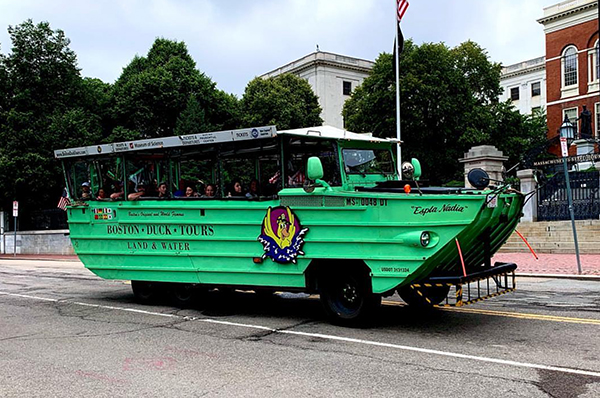
On the afternoon of Saturday, June 27, 2026, a Boston Duck Tours vehicle overturned on a boat ramp along the Charles River in Cambridge, injuring multiple passengers and sending one person to Massachusetts General Hospital. According to accounts from the Massachusetts State Police and reporting by the Boston Globe, CBS Boston, and other outlets, the duck boat had broken down while on the water and was being towed up the ramp near the Lynch Family Skate Park by a second duck boat when the tow rope snapped. The vehicle rolled backward and tipped onto its side with roughly 31 people aboard.
Early reports described six injuries; those figures were revised upward through the day to as many as eleven, including at least one person who was trapped inside the vehicle and had to be extricated before being transported to the hospital. Witnesses described passengers tumbling into one another as the boat went over — and noted that the vehicle had no seat belts. Boston Duck Tours suspended operations for the remainder of the day and said it was reviewing the incident with the Massachusetts State Police and the U.S. Coast Guard.
While investigators work to determine exactly what failed, passengers who were hurt are left with a more immediate question: what now?
First steps for anyone injured
The hours and days after a crash like this matter, both for your health and for any claim you may later decide to pursue. A few practical steps tend to make the biggest difference:
Get medical attention, even if you feel “okay.” Adrenaline masks injuries, and the symptoms of concussions, soft-tissue damage, and internal injuries can take hours or days to appear. A prompt medical evaluation protects your health and creates a contemporaneous record connecting your injuries to the incident.
Document everything you can. Photographs of the scene, the vehicle, the ramp, and your injuries are valuable. So are the names and contact information of other passengers and any witnesses, and any incident or report number assigned by responding agencies. If you were given paperwork at the scene or the hospital, keep it.
Preserve your account while it is fresh. Write down what you remember: where you were sitting, what you heard, what you felt, and the sequence of events, before time and retelling blur the details.
Be cautious with early statements and offers. Insurers or company representatives may reach out quickly. You are not obligated to give a recorded statement or to accept any settlement before you understand the full extent of your injuries.
Talk to a personal injury attorney before signing anything. An early consultation helps you understand your rights and avoid steps that could undercut a future claim.
The legal questions this kind of accident raises
Amphibious “duck boats” sit at an unusual intersection of the law. On land they behave like a vehicle; on the water they are a vessel. An incident that happens on a boat ramp, partway between the two, can raise questions about which body of law applies, including the possibility that federal maritime law governs some claims rather than ordinary Massachusetts negligence rules. That distinction can affect deadlines, available damages, and where a case must be filed, which is one reason these matters benefit from early, experienced legal review.
Beyond the jurisdictional wrinkle, the core questions are familiar ones in any injury case. Was the equipment here, a tow rope that reportedly snapped, adequate and properly maintained? Was the disabled vehicle handled according to the operator’s own training and safety procedures? Were there warning signs that the vessel should not have been on the water, or that the recovery should have been carried out differently? Potential avenues of responsibility can extend beyond the operator to equipment manufacturers or maintenance providers, depending on what the investigation reveals.
In Massachusetts, the general statute of limitations for personal injury claims is three years, but the maritime overlay and the involvement of a commercial operator can complicate the timeline. Acting sooner rather than later helps preserve evidence and keeps every option open.
A pattern of safety concerns
This is not the first time duck boats have drawn scrutiny — in Boston or nationally.
In April 2016, 28-year-old Allison Warmuth was struck and killed by a Boston duck boat while riding a motor scooter. The NTSB’s review found the driver had turned away from the road to point out landmarks. That tragedy pushed Massachusetts lawmakers to pass a law prohibiting duck boat drivers from also serving as narrator and requiring the vehicles to be equipped with blind-spot cameras and proximity sensors. Years earlier, in 2003, a passenger named Rosemary Hamelburg fell from a Boston duck boat and later died; her family alleged the operator failed to follow its own boarding safety procedures, and Boston Duck Tours settled the wrongful-death claim for $425,000.
The water-borne risks have been even more severe elsewhere. In 1999, the Miss Majestic sank near Hot Springs, Arkansas, killing 13. In 2018, the Stretch Duck 7 sank on Table Rock Lake near Branson, Missouri, during a sudden storm, killing 17 — one of the deadliest passenger-boat accidents in modern U.S. history. The National Transportation Safety Board has repeatedly faulted the design of these World War II–era vehicles, citing low buoyancy and fixed canopies that can trap passengers, and has criticized the U.S. Coast Guard for not acting on safety recommendations issued as far back as the 1990s. Safety advocates note that duck boats have been linked to more than 40 deaths since 1999.
Saturday’s rollover did not end in the water, and for that everyone involved is fortunate. But the incident is a reminder that these vehicles carry real risks, and that the people most affected are paying passengers who placed their trust in an operator.
If you were on board
If you or a family member was injured on the Charles River duck boat, you do not have to sort through the medical, insurance, and legal questions alone. The team at Keches Law Group has decades of experience representing injured people across Massachusetts, including in complex cases involving commercial operators and overlapping areas of law. We offer free, no-obligation consultations and can help you understand your rights and options.
Contact Keches Law Group today to speak with a member of our team.